


Review of the New‑Energy Vehicle Market in H1 2023
01 The New‑Energy Vehicle Market Kept Momentum in H1 2023
According to industry statistics, China’s new‑energy vehicle output reached 3.786 million units and sales hit 3.747 million units in the first half of 2023, rising by 42.4% and 44.1% year‑on‑year respectively. The market share of new‑energy vehicles exceeded 28.3% in H1 2023, reflecting sustained market expansion. In June alone, monthly output and sales of new‑energy vehicles grew by 32.8% and 35.2% year‑on‑year, with the market share climbing to 30.7%.
By powertrain type, plug‑in hybrid electric vehicles (PHEVs) posted robust growth. Their H1 2023 sales stood at 1.025 million units, representing a record‑high year‑on‑year increase of 91.1%. Battery electric vehicles (BEVs) recorded sales of 2.719 million units and remained the dominant segment, accounting for 72.6% of total new‑energy vehicle sales in H1 2023, with a year‑on‑year growth of 30.3%.
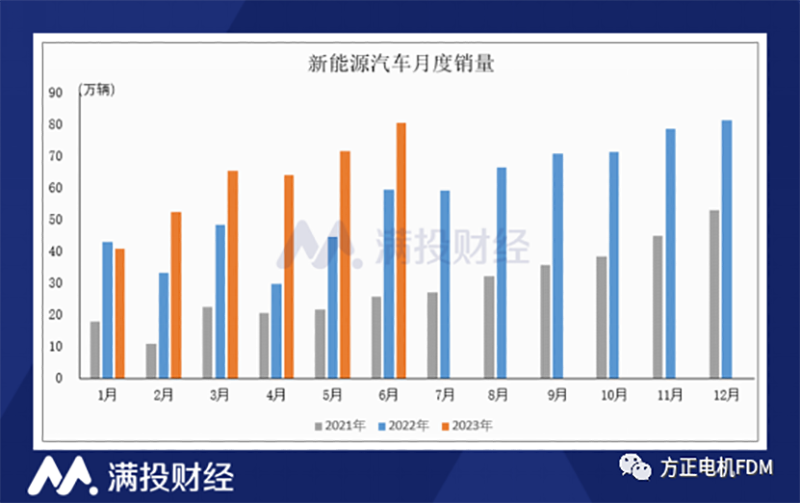
(Data source: China Association of Automobile Manufacturers)
02 Enhanced Policy Support Drives a Rebound in Industry Demand
Policy support has played a vital role in the recovery of the new‑energy vehicle sector.
At the beginning of 2023, affected by the phase‑out of automotive subsidies and price cuts of fuel‑powered vehicles grabbing market share, China’s new‑energy vehicle market showed weakness after pre‑empted demand ahead of subsidy withdrawal. New‑energy vehicle sales saw a rare decline, hitting multi‑month lows both year‑on‑year and month‑on‑month. CAAM data showed that new‑energy vehicle sales reached 408,000 units in January 2023, down 6.3% year‑on‑year and 50% month‑on‑month. Although the market gradually recovered with new model launches and price wars, growth came under pressure again in April. The auto association called for supportive policies for automobile consumption to boost market demand.
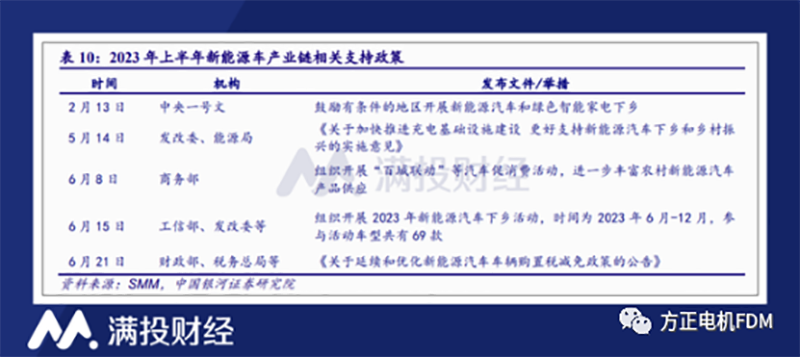
Since the second quarter, central and local pro‑consumption policies have been rolled out frequently, together with the New‑Energy Vehicles to Rural Areas initiative. Preferential policies for new‑energy vehicle consumption were successively introduced across regions. Consumption vouchers and subsidies were issued in Zhengzhou, Shenyang, Hainan, Shenzhen and other cities, effectively lifting industry demand.
Meanwhile, on June 21, the Ministry of Finance, State Taxation Administration and Ministry of Industry and Information Technology jointly issued an announcement on extending and optimizing the new‑energy vehicle purchase tax exemption policy. The tax break will be extended to 2027 with phased implementation, providing strong sustained support for new‑energy vehicle consumption.
Xu Wen, Researcher at Chinese Academy of Fiscal Sciences, commented that extending and optimizing the purchase tax exemption will stabilize market expectations, improve the consumption environment, further unlock consumption potential and expand effective market demand for new‑energy vehicles.
03 The New‑Energy Vehicle Industry Faces a Long Journey amid Economic Recovery
Looking ahead, the domestic new‑energy vehicle industry is likely to maintain solid growth in the second half of the year based on current trends. According to Galaxy New Energy & Power Equipment Research, combined with forecasts from CPCA and IEA, China’s new‑energy vehicle sales are expected to reach 8.5 million units in 2023, up 26.3% year‑on‑year, while global sales are projected at 14 million units, a 29.3% year‑on‑year increase. Benefiting from the long‑lasting favorable policies, the sector will keep receiving policy backing.
Domestic policies for stable economic growth are taking effect. As a pillar of national economy, the real‑estate sector is still in recovery, which makes the mission of the automotive industry even more challenging. Sustained high export growth enables the automotive industry to play a key role in boosting domestic demand and foreign trade. Under such economic backdrop, the auto industry, with new‑energy vehicles as its major growth driver, is expected to maintain high prosperity.
Hundreds‑of‑millions Units Power the World, Intelligence Leads the Future Journey
2026.05.22
Liu Zhiwei conducts special research at Founder Motor
2025.09.29
Thirty Years Established, Powering the Future — Founder Motor 30th Anniversary
2025.09.05
2023 Annual Report of Founder Motor (002196)
2024.05.28
Founder Micro Motor (Lishui)Co.,Ltd. officially set sail
2023.04.11